Whether they compose a bridal bouquet, send a heartfelt message of love, or fill a room with their fragrance, flowers celebrate the self-renewing beauty and vitality of nature. Shouldn’t they be grown in a way that honors that idea?
Sustainability has always been part of the foundational philosophy at Alexandra Farms. We value it for its own sake, and over the long term, growing responsibly also yields the consistent quality our partners rely on.
It’s much more than a label or a trendy marketing scheme. It’s a way of life and a business strategy, and every effort below is reviewed and verified by independent, third-party auditors.
Our responsibility to the land
How we protect and restore the land we grow on, with the numbers behind each commitment.
Fewer Chemicals, by Design
One of the biggest concerns for flower farmers is minimizing pesticides. In our greenhouses, the tallest budding garden roses wear mesh mitts, hand-sewn at the farm from a medical-grade weave fine enough to block even the spores of botrytis mold. They’re washed regularly and reused. For the past several years we’ve also relied on beneficial insects to control pests naturally, including a predatory spider species used to keep harmful spiders in check. When spraying is still necessary, our team is trained in the safe use of every active ingredient, wears proper protective clothing, and to safeguard reproductive health, women do not handle pesticide application. Together these methods have reduced our pest spray by more than 50 percent.
Water, Captured and Reused
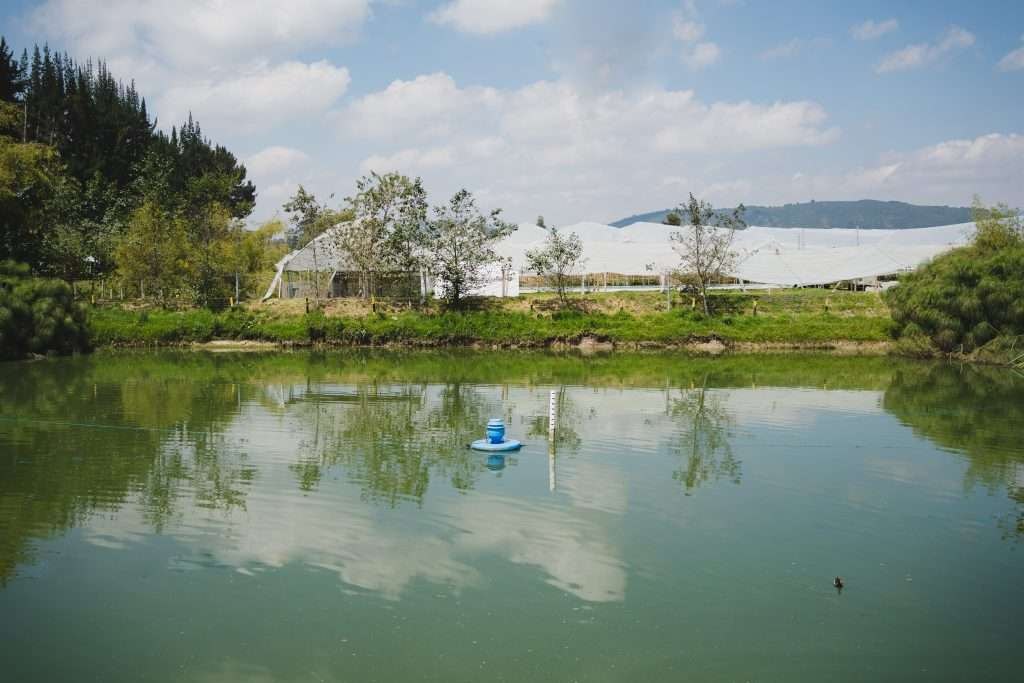
Water conservation protects the groundwater of the Bogotá savannah. Rainwater is collected and stored in large reservoirs and used to irrigate our plants. In our hydroponic greenhouses, 100 percent of the water is recycled. In the soil growing areas, irrigation water and fertilizer solutions are collected in channels after use and flow back into the reservoirs, so they’re reused rather than lost as runoff that could carry fertilizer into the natural environment. For safety, every reservoir is fenced and clearly signed, with life rings stationed around its edge.
Healthy Soil, Living Land
Alexandra Farms uses coconut fiber and rice husks as a growth medium, a practice that helps conserve the soil and avoids the harsh chemicals and fertilizers that could affect the land and the people near it. Everything green from the plants themselves, from discarded plants to fallen leaves, is composted and reintegrated into the soil. All paper and plastic is recycled. Around the greenhouses, unproductive areas have been replanted with native species that provide habitat for wild birds and other creatures.
Measured, Offset, Verified
Our carbon neutrality isn’t a slogan. Our footprint is measured every month and was independently verified at 1,150.43 tonnes of CO2e across both farms. Our location near the Equator is a real advantage: because the climate is steady year round, our greenhouses need no heating, cooling, or artificial lighting. Flowers grown in heated, lit glass greenhouses elsewhere carry a much higher carbon footprint, and even after we add the freight of shipping our garden roses to market, our total carbon release is lower. To offset what remains, we’ve planted 2,880 native trees around our facilities (1,430 in 2021 and 1,450 in 2022), report emissions monthly to Asocolflores, and are now exploring solar power.
Our responsibility to our people
Garden roses are grown entirely by hand, so a valued, well-cared-for workforce is everything.
Health and well-being
Our people receive far more than a fair wage. Benefits include medical, dental, and vision insurance, with a doctor visiting the farm twice a month, a healthy meal every day, mental-health support, and lactation rooms for new mothers.
A voice and a community
Employees have a genuine voice through safety and well-being committees, with financial assistance available when it’s needed. The whole farm comes together for family celebrations and activities through the year, and there’s no child labor on any of our farms.
Women and opportunity
Steady, fairly paid work changes a life, and as it does, it changes the community around it. For the many women on our team who are heads of their household, that ripple reaches their children and their neighbors too.
Pride in every stem
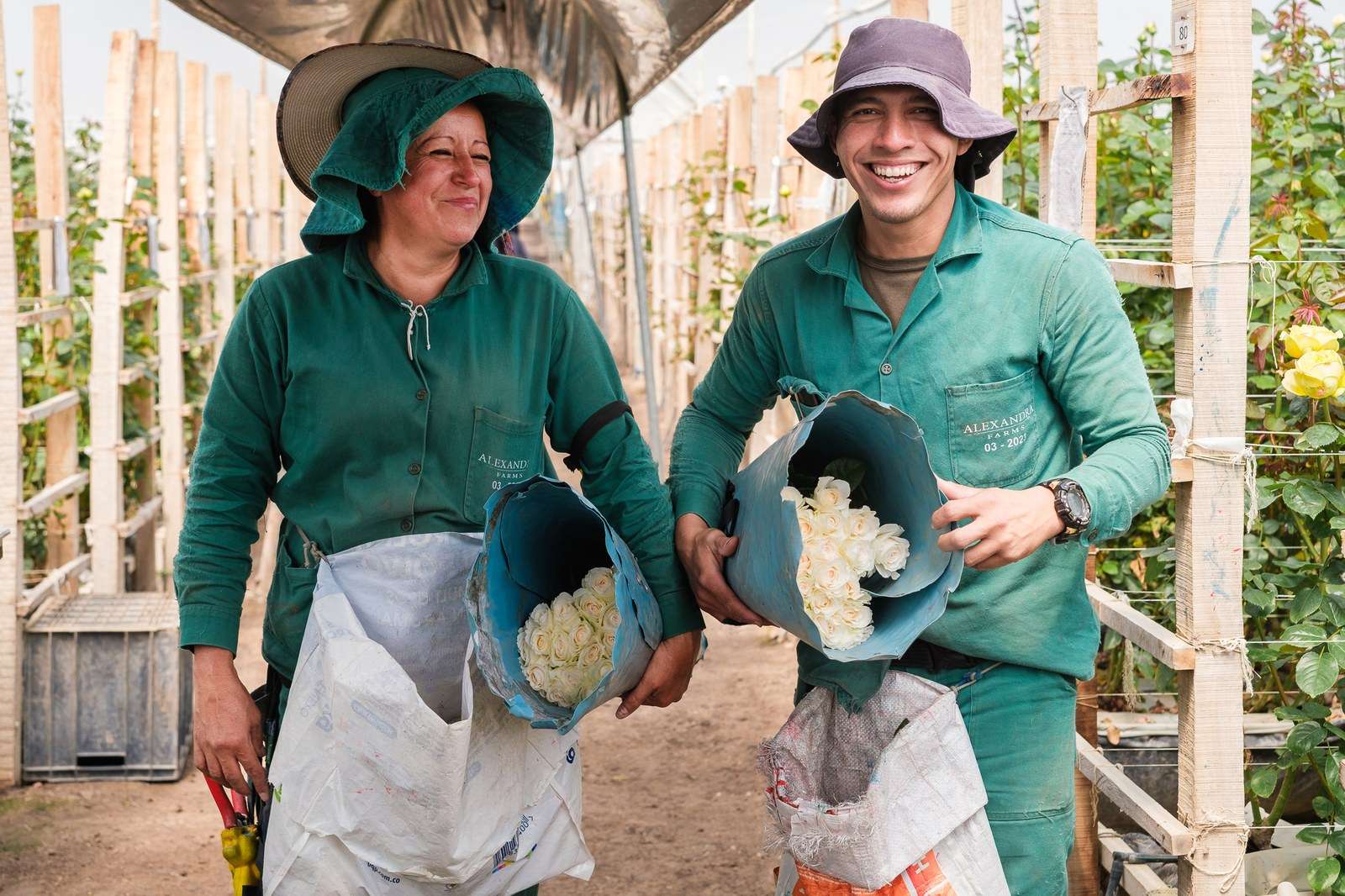
Every garden rose is grown and cut entirely by hand. Each rose bed is assigned to a specific person, and every bunch is signed with a sticker bearing the name of the employee who packed it. In the packing areas, employees even help design their own workstations, improving both efficiency and the care taken with every stem.
Giving women a paycheck has changed the social dynamic in rural Colombia. As women gain purchasing power, whole communities change with them.
Jose R. Azout, Founder
Independently Certified
Our claims aren’t self-graded. Each certification below is awarded and renewed by an outside body that audits our farms on site.
Certified since 2013 and renewed every year. Colombia’s voluntary program sets some of the world’s highest social and environmental standards. Both our San Ignacio and El Jardín farms are audited on site by independent verifier Naturacet.

The Carbon Neutral International Standard, awarded through One Carbon World in support of UN Climate Change (UNFCCC). We measure our footprint every month against the GHG Protocol (ISO 14064, PAS 2060) and offset what remains.

Business Alliance for Secure Commerce, certifying secure, legitimate trade practices throughout our supply chain, in voluntary cooperation with governments and border agencies.
Sustainability is much more than a label at Alexandra Farms. It is a way of life and a core part of how we do business: a promise that every garden rose is grown in a way that protects the land and water it depends on, supports the people who tend it, and leaves the farm and the community around it stronger for the generations that follow.