Design Versatility, Proper Care & Handling of Spray Roses
Guest post by Amy Balsters
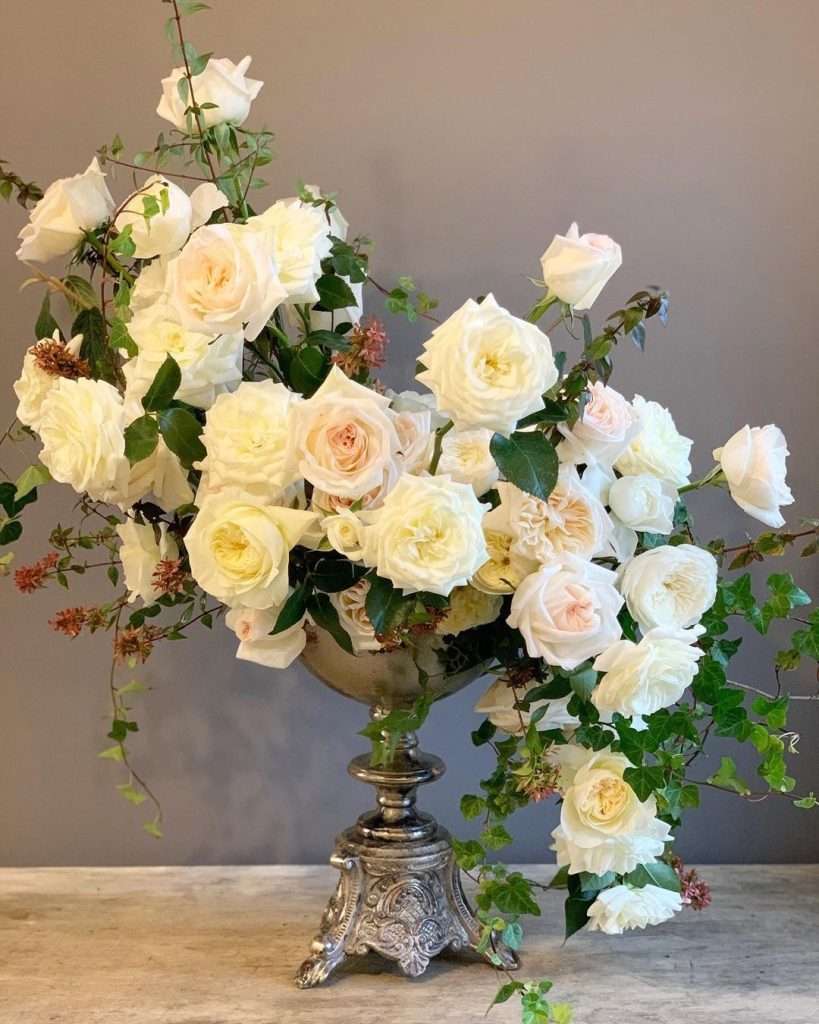
Spray roses are one of the most versatile flowers available! They add stunning depth, color, and interest to bouquets and centerpieces. They can also confidently stand as a single stem in a bud vase, face-crushing hug after hug in a boutonniere, delicately lay as hair flowers, and withstand hours without a water source in an installation. These powerhouse stems are a go-to in my design work.
Proper Care & Handling
Spray roses can be best appreciated after receiving proper care. Hydration and careful handling will allow spray roses to fully open without damage and will ensure the performance and longevity of these stems. I always use a hydration solution when processing spray roses. I allow the roses to hydrate with the packaging on to ensure their stems straighten. Like I do with all flowers, I remove any foliage that will sit below the waterline. After initial hydration, remove the packaging and remaining foliage (if desired) to allow your bloom heads to open.
Here are the steps in a checklist:
Step 1: Prepare hydration solution with cool, deep water.
Step 2: Keep packaging on while processing.
Step 3: Remove foliage that will sit below the waterline.
Step 4: Trim ½ to 1 inch off the bottom of the stems with sharp, clean shears.
Step 5: Hydrate the roses with the packaging on for at least one hour.
Step 6: Remove the packaging and, if desired, remove all remaining foliage, if desired.
With proper care, Alexandra Farm garden spray roses can last 10-12 days!
Watch a complete how-to on this process.
Using Spray Roses in Design Work
Spray rose varieties can differ in open rates. I like to receive them a few days before my event and let them open out of the cooler. Once they near peak bloom, I place them back in the cooler so they are primed but protected for event day. In a retail setting, keep spray roses in the cooler for maximum freshness and longevity.
When I design with spray roses, I like to review each stem to determine its best use case. Spray rose stems with multiple blooms at the same or similar height are terrific for coverage and depth. Spray roses with laterals at varying heights are a natural choice for creating flowing, terraced lines in designs. Spray roses with attractive or unique profiles are more likely to float in my designs.
All of the roses featured here are from Alexandra Farms. They truly grow the most magnificent roses. I’ve been to their farm and seen with my own eyes how exceptional their process is! They grow seven varieties of spray garden roses (my fave) and are releasing two more this spring. Their spray garden roses are bred in France and Japan and have won several awards from both the Society of American Florists’ Outstanding Varieties Competition and Proflora’s Outstanding Variety Competition over the past few years.
Spray roses are one of the first stems I reach for as I make my bouquets. When their most attractive feature is their face, I use them deeper in my bouquets so they are facing the viewer. Loli Spr pairs attractively with mauve and peach blooms like ranunculus, zinnia, celosia, Miyabi and Millicent.
With long laterals and a unique profile, Princess Midori Spr is best used to create unique lines in an arrangement.
To learn more tips on designing with spray roses and see a complete spray rose processing and design demo, be sure to watch the video above.
“The color of the roses were absolutely cosmic! The way each color variety really complimented the other colors was perfect.”
– Canaan Marshall
“I was pleasantly surprised by how big the actual rose petals and buds were. The roses had really strong and hearty stems which made the flowers just that much better. They were fabulous!”
– Canaan Marshall
Garden Roses Make the Perfect Match: Three Takes on Pairing Flowers with Our Blooms for Weddings
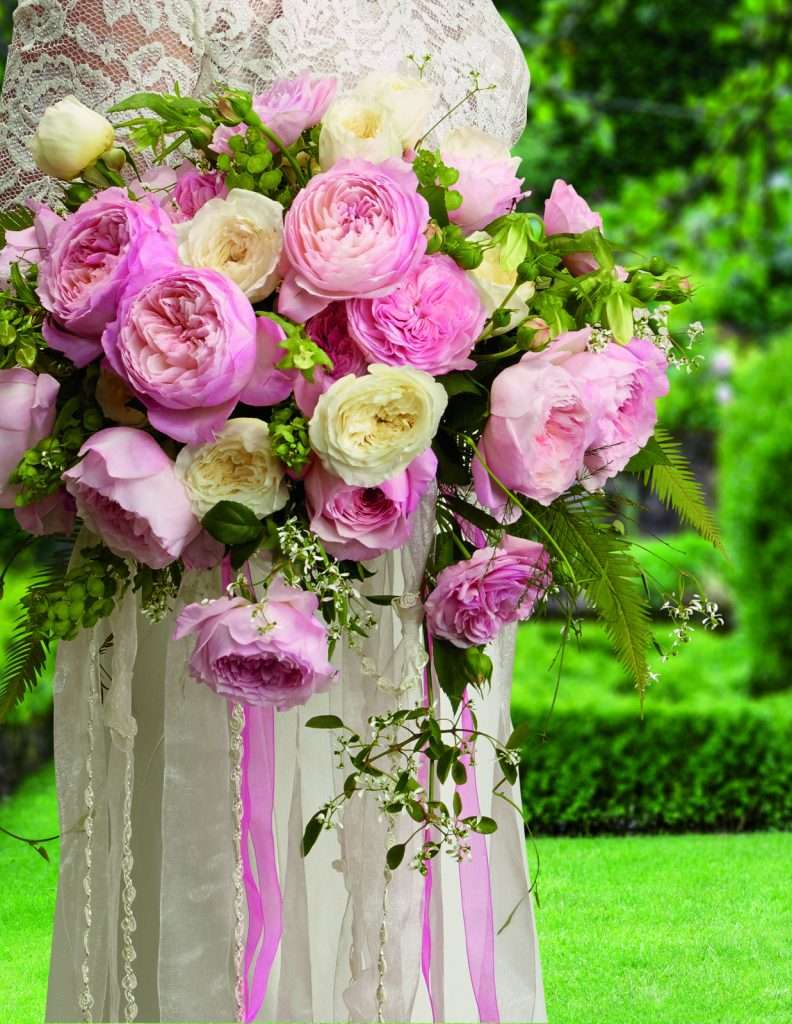
Let’s start with the premise that a wedding must have garden roses! Maybe one particular variety has been selected as a signature flower, a keynote for the wedding’s theme and color scheme. What do you combine with that rose, in the bridal bouquet and wherever else it may appear, to make the most of its beauty and value?
Of course, every designer has a different answer to that question. That’s why we posed it to three of the world’s top floral designers: Holly Heider Chapple, René van Rems AIFD, and Hitomi Gilliam AIFD. Each came up with a different set of stimulating ideas.
New Colors and Forms
“First of all, I think everything looks amazing with garden roses!” So says Holly Chapple, of Holly Heider Chapple Flowers, Hope Flower Farm, and the Chapel Designers collective. But if you really want your garden roses to be the top players in the event, the king and queen of the wedding, one way to do that, she continues, is by combining them with flowers that have a completely different shape.
“You can choose to skip the peonies and ranunculus and instead pair your roses with unique greenery and with things like stock, larkspur, and snapdragons,” Holly suggests. That’s a strategy that lets the roses dominate the design, in part because, from a budget point of view, it may allow you to use more garden roses and fewer of the other flowers.
If, on the other hand, you still prefer to mix garden roses with other round flowers, you can’t go wrong with spray roses, adds Holly. With three to five laterals to a stem, they fill the spaces between bigger flower heads beautifully, with complementary color, texture and form. Some of Holly’s favorites, in the past, have included White Majolica or Jeanine, for white spray roses; hot pink Gem Star; peach Ilsa; and antique, peachy pink Antigua.
Now, as of spring 2021, Alexandra Farms has garden spray roses to choose from: pure white Blanche, blush white Wedding Rosever, golden peach Sahara Sensation, and three elegant Japanese spray roses in the Wabara Collection: Aio Fuga in lavender-tinted pink, Ioli in antique lavender, and dusty pink Sola.
“All of the new spray roses are extraordinary!” says Holly, who saw them as trial varieties on a visit to the farms, a year before they were introduced commercially. “They are providing us with colors and forms that we never had in spray roses before.”
Holly also loves carnations, typically massed together at a lower level below the garden roses, adding depth and texture to a bridal bouquet or any wedding design. Among her favorites: Lege Marrone, a beige carnation, sometimes with pink petals in the center; peach Lizzy; and blush beige Caramel. “Those tones are beautiful with Juliet, Miyabi, Romantic Antike, any of the whites,” says Holly.
Like and Not Like
For Dutch-born designer René van Rems, the key to making garden roses stand out is to think outside the box. On the one hand, other flowers and foliages with a garden look make natural companions for garden roses: border perennials, say, like delphinium, sweetpeas, columbine, lupine, digitalis, phlox, Alchemilla mollis (lady’s mantle), along with garden foliages like dusty miller and geranium or caladium leaves.
Part of what makes all of these flowers and foliages work well together is that they share a fuzzy or papery, soft-tissue texture. And in fact, as true garden plants, they have not always been easily available as cut materials from professional suppliers to the floral industry. But with the growth of the Slow Flowers movement, they can now be obtained, in season, from local growers in many parts of the country.
Where René urges designers to get adventurous is with color and form. Many (not all) garden roses come in soft, blush tints. Consider combining those tints with stronger, more vivid hues in the same color family: butter-yellow Beatrice, for example, with bright orange calendulas. Edith’s pale gold-apricot interior, surrounded by soft pink outer petals, could be possibly matched with a gloriosa lily in glowing yellow and magenta.
“By adding in colors that pop but also harmonize with the roses, you get away from those washy, predictable pastels,” says René. Gloriosa is an example of a flower that can harmonize in color yet contrast with the rose in form; others would be clematis, vanda or cymbidium orchids.
Round, mass flowers can also combine with garden roses for a lush, romantic, Old World look, René concedes. Be careful, though, to avoid composite flowers with ray petals and a strong central eye, like gerberas, sunflowers, or Café au Lait dahlias. Pompon dahlias or other round flowers, lisianthus or ranunculus, mums or carnations, are fine.
“If you have a composite flower with a strong center, the eye goes to that center,” warns René, “and it completely distracts from the voluptuous effect of all the other round flowers.”
Respect for Royalty
When Hitomi Gilliam AIFD first began promoting a floral design trend she calls tropical nouveau, she really had not only tropical flowers but garden roses at top of mind. “Brides would come to Hawaii for their destination weddings and insist on getting all their flowers shipped from the mainland, including garden roses,” she remembers. “I wanted to show them how they could have what they wanted and also include some local color.”
Indeed, color is the key. “People used to think that tropicals came only in red and green,” said Hitomi. “They don’t know about the pinks and peaches,” the creamy whites and the pale greens.
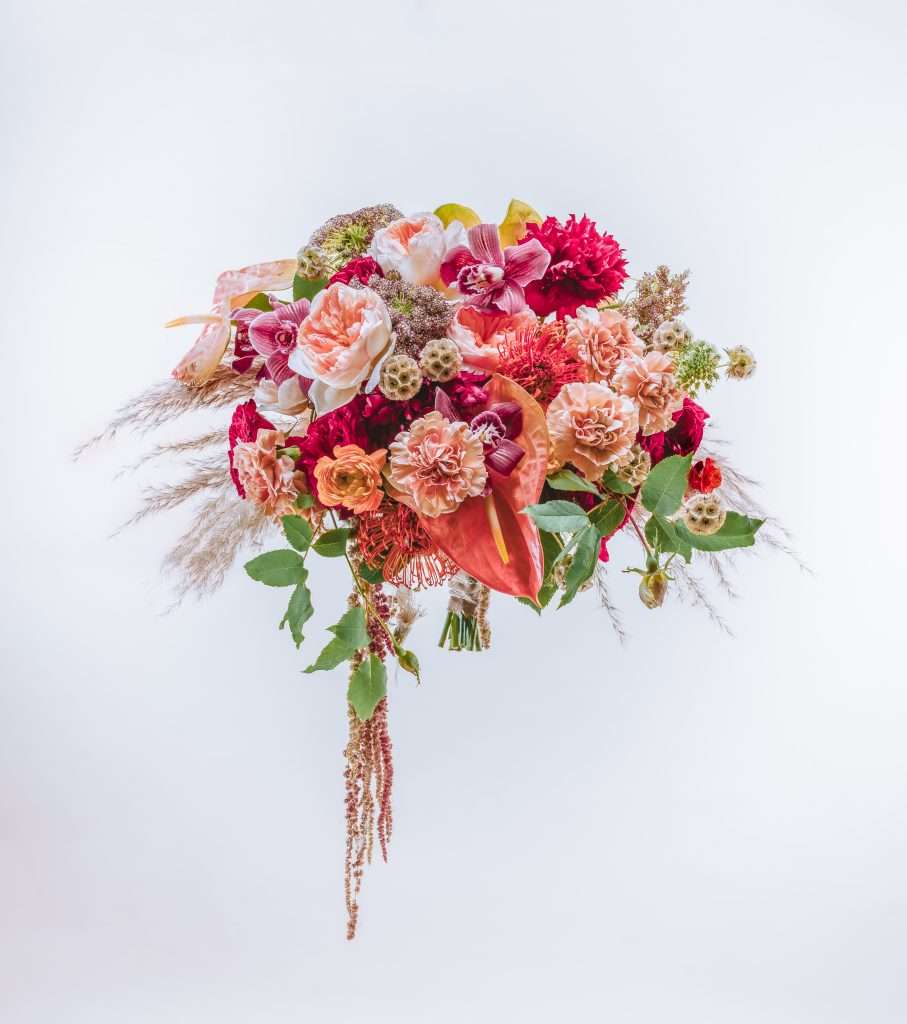
For wedding flowers that include tropicals in that soft, romantic color scheme, Hitomi’s first thought was to pair them with garden roses. “They are perfect for that, precisely because they are the total opposite of tropicals,” she explains. Put the soft, ruffled texture of garden roses next to the smooth surface of an anthurium or a broad-leaved tropical foliage, and the texture of the rose comes to the fore.
“It really plays up the garden rose,” says Hitomi. “The tropicals become like a supporting court. And you always want the garden rose to be the queen.”
Imagine, for example, pairing Juliet roses with either of Hitomi’s two favorite peach-colored anthuriums. Toyama Peach is an obake anthurium in a soft peach, often with a greenish edge. Cognac, a Dutch-bred anthurium, combines peach and green with brownish, muddy tones, perfect for color-blending with garden roses like Quicksand, Caramel Antike, or Golden Mustard.
Not all anthuriums are glossy, Hitomi points out. Many tulip anthuriums (Anthurium amnicola) offer a matt surface. Tropic Lime is one example, with a light green tint that absorbs rather than reflecting light. The cup-shaped bract can be used to cradle a garden rose, almost like extravagant, light green foliage.
Or, combine a light pink garden rose, say, Princess Hitomi, with variegated ti leaves. “The colors in those leaves can go from the most brilliant green to the most subtle pink,” says Hitomi. “It just sings, because of the mix.”
Whether or not the wedding takes place in Hawaii or another tropical destination, for the adventurous bride, tropical flowers can make garden roses stand out in all their splendor. “The big message is about respect for royalty,” says Hitomi. “If you are using garden roses, the other flowers should complement, not compete.”