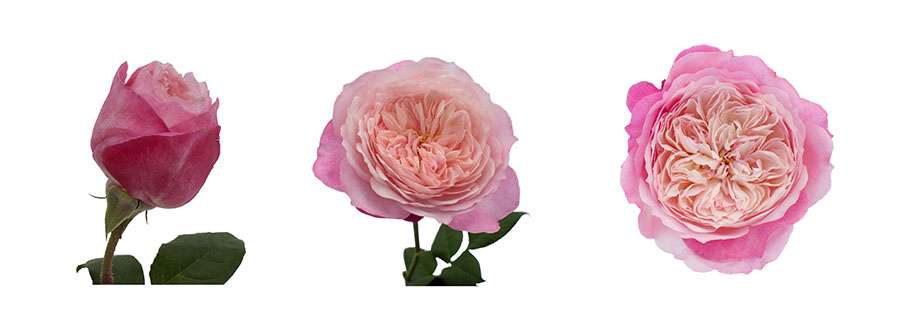
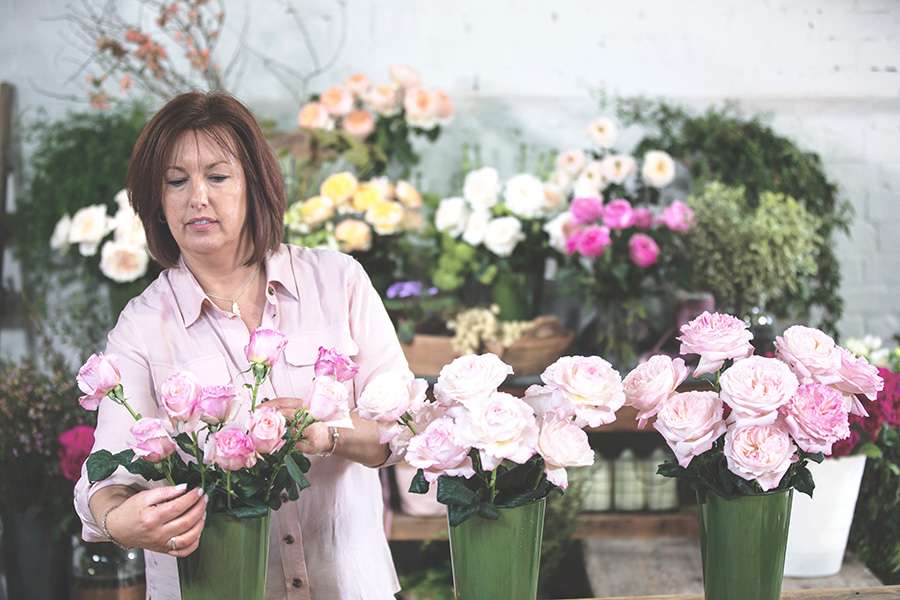
Design Versatility, Proper Care & Handling of Spray Roses
Guest post by Amy Balsters
Spray roses are one of the most versatile flowers available! They add stunning depth, color, and interest to bouquets and centerpieces. They can also confidently stand as a single stem in a bud vase, face-crushing hug after hug in a boutonniere, delicately lay as hair flowers, and withstand hours without a water source in an installation. These powerhouse stems are a go-to in my design work.
Proper Care & Handling
Spray roses can be best appreciated after receiving proper care. Hydration and careful handling will allow spray roses to fully open without damage and will ensure the performance and longevity of these stems. I always use a hydration solution when processing spray roses. I allow the roses to hydrate with the packaging on to ensure their stems straighten. Like I do with all flowers, I remove any foliage that will sit below the waterline. After initial hydration, remove the packaging and remaining foliage (if desired) to allow your bloom heads to open.
Here are the steps in a checklist:
Step 1: Prepare hydration solution with cool, deep water.
Step 2: Keep packaging on while processing.
Step 3: Remove foliage that will sit below the waterline.
Step 4: Trim ½ to 1 inch off the bottom of the stems with sharp, clean shears.
Step 5: Hydrate the roses with the packaging on for at least one hour.
Step 6: Remove the packaging and, if desired, remove all remaining foliage, if desired.
With proper care, Alexandra Farm garden spray roses can last 10-12 days!
Watch a complete how-to on this process.
Using Spray Roses in Design Work
Spray rose varieties can differ in open rates. I like to receive them a few days before my event and let them open out of the cooler. Once they near peak bloom, I place them back in the cooler so they are primed but protected for event day. In a retail setting, keep spray roses in the cooler for maximum freshness and longevity.
When I design with spray roses, I like to review each stem to determine its best use case. Spray rose stems with multiple blooms at the same or similar height are terrific for coverage and depth. Spray roses with laterals at varying heights are a natural choice for creating flowing, terraced lines in designs. Spray roses with attractive or unique profiles are more likely to float in my designs.
All of the roses featured here are from Alexandra Farms. They truly grow the most magnificent roses. I’ve been to their farm and seen with my own eyes how exceptional their process is! They grow seven varieties of spray garden roses (my fave) and are releasing two more this spring. Their spray garden roses are bred in France and Japan and have won several awards from both the Society of American Florists’ Outstanding Varieties Competition and Proflora’s Outstanding Variety Competition over the past few years.
Spray roses are one of the first stems I reach for as I make my bouquets. When their most attractive feature is their face, I use them deeper in my bouquets so they are facing the viewer. Loli Spr pairs attractively with mauve and peach blooms like ranunculus, zinnia, celosia, Miyabi and Millicent.
With long laterals and a unique profile, Princess Midori Spr is best used to create unique lines in an arrangement.
To learn more tips on designing with spray roses and see a complete spray rose processing and design demo, be sure to watch the video above.
Timing Is Everything When It Comes to Harvesting Garden Roses
What makes garden roses so special? Nature, of course, but also nurture.
Each garden rose variety grown at Alexandra Farms is heir to a long line of ancestor roses, bred over centuries for exquisite color, elegant form and evocative fragrance. But to reach their full potential in a vase or in a bouquet, these roses require special care, both before and after they are cut.
The point of cut – or timing of the cut – is a key factor. Cut too soon (as might be the case with the same variety from another farm) and a garden rose will not open as fully as the promise of a garden rose demands. Cut too late and the rose is at risk of getting bruised during shipping; it may also open too quickly, rather than at a stately pace, unfurling day by day.
Knowing when that fleeting moment has arrived in the rose’s development that is the perfect point of cut requires a watchful, variety-specific expertise. “We make exhaustive tests to determine the ideal cut point for each variety,” says Jose (Joey) Azout, president of Alexandra Farms.
Armed with that knowledge, workers circle back through the beds to catch the rose when it is finally ready. “We’re one of the only farms that I know of that cuts more than once in a day, twice or sometimes three times in a day if it’s very sunny, which makes the roses develop faster, to get the point of cut exactly right,” Joey continues.
Preparing that open-cut rose for its ultimate destiny demands further attention and care. That’s why garden roses from Alexandra Farms are packed in dozens instead of twenty-fives, because the open cut means the roses require extra room in the box and extra care in packing.
The result is a rose that opens in the vase to its maximum size and value, with its many petals and its subtle, blended colors on full display, and that releases its fragrance with a generous abandon.
Well-Nourished
In general, garden roses are cut at a more open stage than ordinary roses. Does this take away from their vase life? Not at all.
At one time, all roses grown for the florist market were cut and shipped very tight. The perception was that a rose that was even partially open was “old” and starting to mature. Not only florists but many florists’ customers shared this perception. Roses that were shipped tight may or may not open in the vase, and if they did, generally they would not open all the way.
Then, growers in South America began catering to the Russian market. Russian customers preferred cut roses with large, many-petaled heads that were wide open at the time of sale. To reach that stage of openness, roses had to be cut at a later phase of maturity.
To everyone’s surprise, the “Russian cut” roses didn’t suffer in terms of longevity. It’s true that they were more expensive to ship. But it turned out that when the rose spends just a little more time attached to its roots and connected to the soil, it is that much stronger and healthier when it’s cut. Its stem is thicker, its leaves larger and more numerous. In the harvesting practices for premium roses, a revolution was born.
Think of the difference between an ordinary and premium rose like the difference between a supermarket and garden tomato. The one that ripens on the vine is the one that brings to the table all the color, texture and flavor that we associate with “real” tomatoes. The other is a pale imitation.
The Kindest Cut
With garden roses, where the aesthetic is all about opening wide over a period of many days, the cut point is even more crucial, and more variable. In general, the more petals contained in a single bloom, the longer the rose should remain on the stem before it is cut.
Employees at the farms must know the different varieties very well because each has a slightly different cut point. The workers who harvest the roses must have special expertise to recognize just when a rose is ready for harvest. That’s why each rose bed on the farm is assigned to a particular worker, who also has the specific knowhow to keep that variety’s bed healthy and productive. Their knowledge and expertise are what ensures the garden rose blooms are cut at just the perfect time each day.
So what do we get when nature and nurture join hands? Something close to perfection.
From Bud to Open Bloom by David Austin Wedding Roses
David Austin has created a short video for florists about how to care and open David Austin Wedding Roses.
Take a few minutes to watch the new information video by the team at David Austin Wedding & Event Roses. ‘From Bud to Open Bloom’ not only features their glorious rose varieties but shares the team’s top care and handling tips … this is one you do not want to miss.
You can also download their new care leaflet here.
We are also pleased to publish a Q&A session with David J C Austin, who – with his father – was instrumental in creating these iconic roses that are loved around the world.
Sitting Down With David J C Austin
What was the reason for creating the video ’From Bud to Open Bloom’?
“I’m very aware that we only have to be experts in roses, whereas a florist has to be an expert across all flowers. So this is our opportunity to share knowledge and to ensure that florists, as well as their customers, have the best possible experience. It’s so important that we make this connection with floral designers, wherever they are in the world.”
If you could share one fact or tip with floral designers what would it be?
“Allow time for our roses to open! A closed David Austin bloom is like receiving a beautiful, packaged gift that you’re not allowed to look inside! When my father [David C H Austin] and I set about creating a collection of cut roses nearly 30 years ago, our aim was to bring the beautiful forms and fragrances of old roses back into the world of modern commercial cut roses. We developed the roses to open just like the evolution of a rose in the garden. ‘From Bud to Open Bloom’ helps to highlight this transformation.
So how much time does it take for a David Austin cut rose to open?
“A good question, hence our new video. We are working with Mother Nature and so the answer is never black-and-white – something that florists have to deal with day in, and day out, which is never easy.
Each of our varieties is different – think of them as individual personalities. Some are showy and cannot wait to reveal their beauty like Constance (Austruss) who will open within a day. Whereas the more shy and retiring types such as Tess (Ausyacht) may take up to three or four days to open. This is why we have divided our roses into two categories, shown in the video.
Personally, I never tire of seeing the roses arrive in bud form and watch them transform over a number of days. Take Constance – in bud she is quite a rich pink but when open she reveals an unexpected cream center, with blush pink diffusing through her petals like watercolors.”
Based on your experience, how should floral designers plan their timetables to open your roses for a wedding or event?
As a general rule of thumb, we recommend delivery of our roses approximately four days before an event. For a Saturday wedding, receive the roses on the Tuesday before. This gives you one day to fully hydrate the stems in cold storage followed by a couple of days to open before you start arranging.
We use cold storage to control the speed of opening and ambient room temperature to
encourage the opening.”
Keira (Ausboxer) stems in bud (left), half-opened (middle) and fully open (right).
What’s your advice to a floral designer who may not have used your roses before?
Firstly, work closely with your wholesaler placing your order well in advance for delivery to you on the day you need them. It’s also worth highlighting that our cut rose collection is available to you 12 months of the year.
Secondly, don’t hesitate to reach out to us or ask questions. Although the team are based in the UK, they are talking to florists across all time zones! Email them cutroses (at) davidaustin (dot) co (dot) uk or direct message them on social media @davidaustinweddingroses – they love talking roses!
Thirdly, watch our new video ‘From Bud to Open Bloom’! You may already know the information but on the other hand, you may pick up a useful tip or two that you can share with colleagues. For me, I never stop learning or hearing something new, and to share that information is incredibly valuable.
Wishing everyone a very happy, healthy and prosperous 2021 from us all here at David Austin Wedding Roses.
Garden Rose Introduction and Care & Handling (Russian language)
Floreville created this fantastic video showing our flowers and explaining the importance of proper care and handling when working with garden roses. We’re grateful to our partners like Floreville for sharing this information!
Care & Handling, Using Alexandra Farms Garden Roses For Everyday Designs with J Schwanke
Alexandra Farms’ garden roses have been popular for years for weddings and events. But what some people don’t remember is that these exceptional garden roses have such good quality and lasting power that they can be used for any occasion and even every day!
J Schwanke creates three arrangements using our garden roses in this video from ‘Fun with Flowers and J.’
First, a wedding bouquet featuring the stunning Tiara. This wonderful purple rose with a green cast outer petal looks spectacular with eucalyptus and heather.
Next, Tsumugi (part of the Wabara Collection) is used for a simple elevated centerpiece with red huckleberry.
Finally, a hand bouquet with Sabrina accented with variegated Aspidistra Leaves and dropped into a free form Accent Décor glass vase.
J also talks about why it’s important to order early and process the flowers correctly to give you the best quality, performance and vase life. These roses are beautiful and so long-lasting…a sharp contrast to the delicate garden roses of the past. These wonderful roses will last and last and are perfect for any occasion.
Processing Garden Roses: Sometimes Less Is More
When working with garden roses to create a wedding bouquet or any other design, one of the first questions to ask is, “How much do I really want to take away?”
In general, garden roses will be at their most beautiful when you take away as little as possible. And while removing some parts of the flower may well be necessary, there’s a right and a wrong way to do it.
Prep time is well spent when you are protecting your quality investment in premium garden roses, says J Schwanke of UBloom.com, one of the world’s best-known flower experts. In the past, florists working exclusively with hybrid tea roses often began by stripping away the leaves and thorns, then plucking off the outer petals as a matter of course. Today, the thinking has evolved, and the popularity of garden roses, with their opulent, natural look, is one reason why.
The First Cut: Trimming the Stem
Preparing roses involves one essential step of removal: always cut an inch or more from the bottom of the stem with a clean, sharp knife or bypass cutter, to facilitate renewed uptake of water and nutrients. With garden roses, this is advisable even if you are using a no-cut flower-food solution.
Leaves to Be Desired and De-Thorning Techniques
Rose leaves function as the lungs of a plant. On their underside are pores, called stomata, that facilitate gas exchange. They literally allow the rose stem to breathe. And that “breathing” encourages the flow of water and nutrients up the stem, allowing the cut flower to open and color up.
Leaves that fall below the waterline in a vase or processing bucket tend to favor the growth of bacteria in the water. These leaves should always be removed with a clean, sharp knife. And yes, often you will need to remove all the leaves on a rose stem to accommodate your design. But whenever possible, it’s helpful to the vase life of the rose to leave any foliage intact that won’t be submerged or crushed.
Garden roses from Alexandra Farms, like other roses on the market, do have thorns, but the quantity and quality of the thorns vary quite a bit. Some varieties have more, some less; some have shorter, softer thorns while others are quite sharp and hard.
One technique for dealing with thorns is to break them off by hand, simply pushing them aside one by one. This is time-consuming, and it may cause some tissue damage. A preferable technique is to trim each thorn with a clipper, dulling the point.
Thorns actually help the rose to take up water. And while no one wants to get stuck by a thorn, when thorns and leaves are roughly stripped from the stem, that process runs the risk of tearing at the skin of the rose stem and creating an open wound.
Consider this: any cutting that is done to a rose, including the peeling of guard petals and de-thorning, leaves wounded tissue exposed to floating bacteria and the spores of botrytis mold. “Above the water line, that wound becomes a place where air and bacteria can enter the stem,” says J. Air and bacteria can block the flow of water and nutrients, shortening the rose’s life.
Therefore, when roses are held in buckets or arranged in vases, it’s ideal to remove only those thorns and leaves that fall below the water line. The real key is to do whatever paring and pruning need to be done with minimal damage to the rose.
But if you have especially thorny stems, you may need to resort to grasping the stem with a tool like a stem stripper (J recommends the kind made of flexible plastic and shaped like a flower) or a heavy-duty terrycloth towel. Either of these will remove leaves as well as removing or dulling thorns. Always pull from the top of the stem toward the bottom: conveniently, the thorns themselves point downward. That’s another reason to remove them below the waterline, says J, since they can otherwise tear at leaves as you insert them into a vase or bucket.
Guard Petals: The Guardians of Beauty
Garden roses are famous for their subtle color variations, their high petal count, and the way they open up all the way and hold in that position, like a ballerina on point. The outermost petals play a role in all of that, adding to the fullness of the bloom and the depth of its delicate palette.
These outer petals also have a protective function, that’s why they’re called “guard petals.” With any roses, if the guard petals are truly damaged or appear to be already in a state of decay, they should be carefully removed. But if they are simply a different color, perhaps slightly tougher in texture, consider leaving them in place. In the fully open rose, often the outer petals are pushed down so that from above, only the edges are visible.
Get the ‘Fresh From the Garden’ Look
A natural look, as though fresh cut from the garden, with perfect health and minimal processing, just feels right for garden-rose varieties. That means, when it comes to how much you take away from a garden rose, less is more. The same motto applies to the professional care that you expend in grooming each flower and stem for optimum beauty and performance.
For more tips on getting the most from our garden roses, visit our Care & Handling page.
When Is a Garden Rose at Its Best?
On average, most of our roses will be at their best four to five days after being placed in water. Use them at their optimum opening stage for the full effect of their special shapes. Their impact is tremendous when you use them at their full ripeness! It does nothing for an arrangement or a bouquet to use an Princess Miyuki rose that is tight. On the other hand, when that same Princess Miyuki has been in water for a few days, it is huge, beautiful and will make a great impression.
Tips and Tricks: Optimum Opening Stage
One of the most important things to keep in mind when you’re using garden roses is that it takes a few days in water for the flowers to reach their optimum opening stage for the full effect of their special shapes. Using a garden rose when it is still tight gives you very little bang for your buck. On the other hand, when that same garden rose has been in water for four or five days, the bloom is large, beautiful and will make a real impact!